In This Guide
The Role
The Cannoneer is the class that nobody wants and every team needs. You will get fewer kills per match than a Musketeer. You will feel slow and clumsy compared to the Cavalry. But you will be the player who breaches a fort wall, who shreds an attacker's volley at thirty paces, who turns a stalemate into a victory in three shots.
Your weapon is not your musket — it is the cannon. Master the gun, position it well, and you will rack up assists that win matches even when the killboard doesn't show it.
The Cannoneer is a "force multiplier" class. Your impact is in enabling your team — breaching walls so Musketeers can pour through, scattering enemy lines so Cavalry can charge in. Stop measuring your match by kills.
Loadout & Ammunition
| Weapon | Range | Best Use |
|---|---|---|
| Field Cannon | Very long (300m+) | The whole class. See below for ammo types. |
| Carbine | Medium | Self-defence between cannon shots. Don't rely on it. |
| Cutlass | Melee | Last-ditch. If you're using it, things have gone wrong. |
The cannon takes approximately 12 seconds to reload solo, or 6 seconds with a crew of two. This is the single most important number in the Cannoneer class. Twelve seconds is an eternity in a battle.
Round Shot vs Grapeshot
You will switch ammunition mid-battle. Knowing when is half the class.
Round Shot — The Wall-Breaker
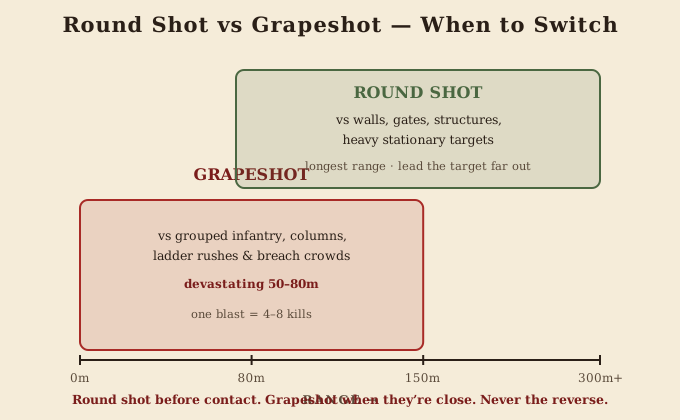
- Use against: fort walls, gates, structures, stationary heavy targets.
- Damage: high, single-target. Tears through fortifications.
- Range: longest. Use for engaging cannons across the map and pre-siege softening.
- Travel time: noticeable — at extreme range you must lead the target.
Grapeshot — The Line-Sweeper
- Use against: infantry clusters, attacking columns, ladder rushes.
- Damage: spread, devastating at 50-80m, useless beyond 150m.
- Best moment: when the enemy has stacked into a doorway, a breach, or a forming line.
- Single shot of well-placed grapeshot can kill 4-8 players at once.
Round shot before contact. Grapeshot when they're close. Never the reverse.
Where to Position
Cannon placement is the most important skill in this class, and it's invisible to scoreboard-watchers. Good positions share three traits:
- Long sightline over an objective or chokepoint — preferably a fort gate, a bridge, or a road.
- Cover behind — you need something to retreat to when Cavalry comes for you (and they will).
- A friendly Musketeer line within 30m — they screen you while you reload.
The classic mistake new Cannoneers make is rolling the cannon to the front line, where the kills look easy. The cannon arrives, fires once, gets flanked by a single Cavalryman, and dies. Position from the second line, never the first.
Cannons cannot pivot fast. The traverse arc is roughly 60 degrees. If an enemy steps outside that arc, you cannot shoot them. Pre-aim toward where threats will appear — not where they are now.
Crewing & Solo Play
If two Cannoneers crew the same gun, reload halves. The math is brutal:
- Solo: ~12 seconds reload. You fire roughly 5 times per minute.
- Crewed (2): ~6 seconds reload. You fire 10 times per minute. Twice the damage output.
If you spawn into a fort defence and see another Cannoneer alone, ping their gun and join them. Two Cannoneers on one gun is significantly better than two Cannoneers on two guns.
Solo Survival Checklist
When crewmates aren't around:
- Pick positions with natural cover behind — a stone wall, a hill crest, a gate corner.
- Keep your carbine loaded between shots. It's a one-tap-on-the-head, but only if it's loaded.
- If you hear hooves, abandon the gun and find cover. A Cannoneer in melee with a Cavalryman is a dead Cannoneer.
- Re-mount the gun after the threat passes.
The Siege Doctrine
Sieges are where the Cannoneer earns their name. The doctrine has three phases:
Phase 1 — Softening (Round Shot)
Before infantry commits to the assault, Cannoneers should put 4-6 round shots into the wall section your team intends to breach. This weakens the structure and signals your line where to attack.
Phase 2 — Breach (Round Shot, escalating)
Concentrate fire on a single section until a visible hole opens. Don't spread shots across the wall — pick one point and commit.
Phase 3 — Storm (Switch to Grapeshot)
The moment your team commits to the breach, switch to grapeshot. Defenders will rush the gap to plug it. A single grapeshot blast into the gap clears the way.
Defenders run the same playbook in reverse: round shot on attacker artillery, grapeshot on attacker columns once they near the walls.
Class Matchups
| Vs. | Favoured | Why |
|---|---|---|
| Musketeer (in line) | Heavily Favoured (with grapeshot) | One blast can wipe a stationary line. |
| Musketeer (skirmishing) | Unfavoured | Hard to hit a moving solo target with a cannon. |
| Cavalryman | Heavily Unfavoured | If they get inside your traverse arc, you die. |
| Cannoneer (artillery duel) | Even | Whoever spots, ranges, and fires first wins. |
| Sailor (on a ship) | Even / map-dependent | Land cannons vs naval cannons — about evenly matched at coastal forts. |
Frequently Asked Questions
When should I use grapeshot vs round shot?
Round shot before contact — against walls, gates and stationary targets at long range. Grapeshot when infantry are close, ideally 50–80 metres, against grouped columns or breach crowds. Never the reverse.
Can the Cannoneer be played solo?
Yes, but it is far stronger crewed. A two-Cannoneer team can flip a fort in three minutes, which is why the class jumps to S-tier in a coordinated group. Solo it sits at A-tier.
Where should the Cannoneer position?
On stable high ground with a clear line to the objective and a covered reload arc. You want maximum sightline over the fort approach while staying out of direct musket and cavalry lanes.
What to Read Next
- Fort Capture — the doctrine your cannon enables.
- Controls Reference — cannon-specific keys included.
- Musketeer Guide — the class that screens for you.