In This Guide
Why Forts Matter
Redcoats.io scoring is simple: hold more forts than your enemy when the match clock ends. Each fort held increases your faction's score over time, and capturing the final enemy fort wins immediately.
This means that a player who scores 30 kills but doesn't help capture anything is worse for the team than a player who goes 0-and-12 standing in a capture zone. Kills feed the scoreboard. Forts feed the win.
The single most important lesson: if you're nowhere near a fort, you're playing wrong. Period.
The Capture Mechanic
Each fort has a capture zone — the central courtyard, typically. Capturing works on three rules:
- Friendlies inside, no enemies inside — the capture meter ticks toward your faction.
- More friendlies = faster capture, up to a cap (~6 players).
- Any enemy in the zone freezes the meter, but they cannot reverse the percentage already gained until they outnumber you.
Practical consequences:
- Even one defender inside the zone halts a 20-player attack. Clear the zone before camping it.
- Once you hit 100%, the fort flips. The previous owners now need to recapture from zero.
- Forts have brief immunity (~30 seconds) after flipping, during which they can't be recaptured. Use the window to consolidate defence.
The Assault Doctrine
A successful fort assault has four phases. Skip any of them and you bleed bodies for no progress.
Phase 1 — Reconnaissance (60 seconds)
Before any push, scout the fort approach. Use the minimap. Identify:
- Which walls are damaged or breached already.
- Where the enemy's Cannoneers are positioned.
- Whether the enemy has Cavalry screening the approaches.
- Which gate or wall section has the lightest defender count.
Phase 2 — Suppression (30 seconds)
Friendly Cannoneers concentrate fire on a single wall section. Friendly Musketeer lines pin defenders behind cover. The goal is not to kill — the goal is to fix the defenders so they can't move freely.
Phase 3 — Storm (the moment of truth)
On voice or chat command, the assault force commits. Three things must happen simultaneously:
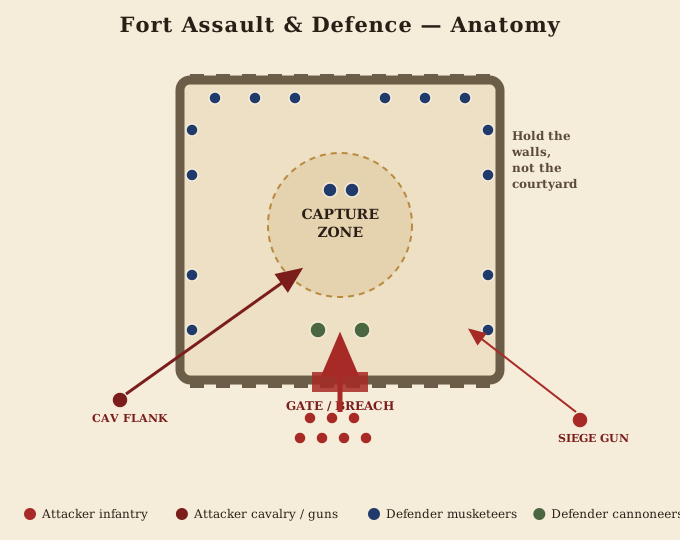
- Infantry pours through the breach or gate in a tight mass — not in single file. Mass beats fire.
- Cannoneers switch from round shot to grapeshot aimed at the entry point — to cut down defenders rushing the gap.
- Cavalry circles wide to intercept enemy reinforcements coming from neighbouring forts.
Phase 4 — Capture (60–90 seconds)
Once inside the courtyard, players must stay in the capture zone. The first wave will fight defenders in the zone; the second wave consolidates; the third wave secures the perimeter.
The number-one mistake on assault is players exiting the capture zone to chase kills. Stay inside. Let the fort tick.
The Defence Doctrine
Defending a fort is, mechanically, much easier than assaulting one — provided you don't blow it.
Hold the Walls, Not the Courtyard
Most new defenders huddle in the courtyard because that's where the capture happens. This is backwards. If the enemy is already in the courtyard, you've lost the wall. Defence happens at the perimeter.
Three Defence Roles
- Wall Musketeers (60% of defenders) — line the parapets. Fire down at attackers crossing the open ground. The musket has range advantage over attackers in the open.
- Gate Cannoneers (15%) — point a loaded cannon at each gate from inside the courtyard. Grapeshot at any breach is devastating.
- Mobile Reserves (25%) — Cavalry and Musketeers held in the centre, ready to plug any breach. Don't commit them until you know which side is the real attack.
Always have one reload behind you. Defending Musketeers should fire from the parapet, then step back from the wall to reload, then return. Never reload while exposed over the wall edge.
Read the Feint
Smart attackers will fake one side and commit the other. If the enemy is making a lot of noise on the east wall but you haven't seen heavy fire yet, expect the real attack on the west. Hold reserves; don't pour everyone to the loudest side.
Team Composition
The ideal composition for an attacking force (per 20 players in your strike group):
| Class | Count | Role |
|---|---|---|
| Musketeer | 12 | Mass fire, capture body |
| Cannoneer | 3 | Breach + suppress |
| Cavalryman | 3 | Flank screen + reinforcement intercept |
| Sailor | 2 (coastal only) | Naval bombardment |
Defending forces typically run heavier on Musketeer (15/20) and lighter on Cavalry. The whole team should never be one class — even a 10:10 Musketeer/Cavalry split loses to a balanced enemy.
Common Counters
Counter: Massed Cavalry Assault
Some attacking teams try to win by drowning the gate in horsemen. The counter is straightforward — a Musketeer line at 60 metres in front of the gate kills horses faster than they arrive. Add one Cannoneer with grapeshot and the assault collapses.
Counter: Cannon Spam
Five Cannoneers softening a wall sounds terrifying. The counter is to send Cavalry on the cannon line — cannons can't traverse fast enough to defend themselves, and their friendly screen is usually thin. Two Cavalrymen with timing can wipe a battery.
Counter: Stale Defence
If defenders never rotate, attackers can pick them off from one position over and over. Cycle defender positions every 60-90 seconds — bottom rank reloads, top rank fires, swap.
What to Read Next
- Current Tier List — which classes excel in fort warfare right now.
- Cannoneer Guide — the class that decides sieges.
- Musketeer Guide — the body of every assault.
- Beginner Guide — if you're new.